

Online social buying
This was a dogfooding usability research study for an online social buying application. The study was conducted with the employees of the organization itself to test the product in real-world usage. The objective was to understand the end-to-end journey of the dogfooders and find the challenges as well as points of improvement of the application.
Research questions
01
02
ORDER PLACING JOURNEY
-
Deal listing: Is the homepage of the application intuitive?
-
Product catalogue: What kind of products are being expected on the platform?
-
Group completion: Test the ideal flow when a new group is being formed only when the previous deal was completed; dig deep into the ways to solve the confusion.
03
ORDER TRACKING JOURNEY
-
Why order updates on the merchant page are not enough? How will the users be notified of it? How will the users know the ETA of the product?
-
Will notification on the chathead help inform about the order or new updates by that merchant?
-
What are the reasons for users not able to find completed orders?
-
What are the order status stages that users are interested in?
ORDER CONFIRMATION JOURNEY
-
Order discount: Understanding the excitement around discounts vs social buying
-
Payment flow: For what type of product, advance vs full payment is expected/preferred?
-
Address input section: How often do users get items delivered to other locations? / What are the expectations for default address vs new address?
Methodology and participant profile
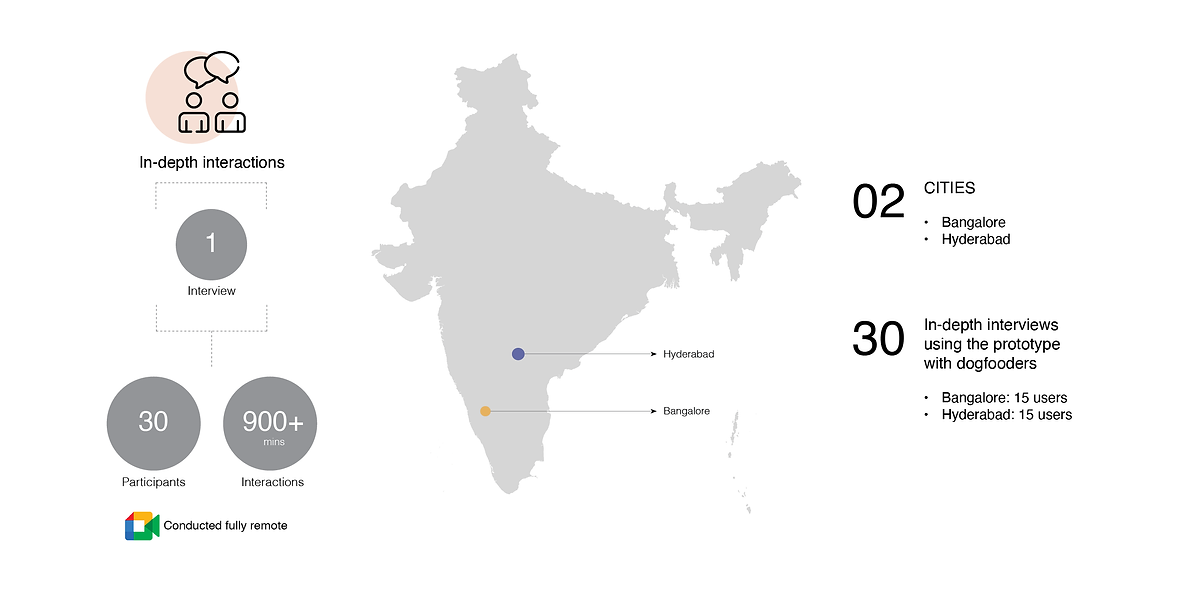
Details of the study
01
Usage & Value
02
Usability & Interventions
How do participants learn? To what extent does Rani contribute to their learning?
To what extent do users want to learn foundational skills in their apps and phones?
What preexisting mental models do users have in regards to trying the product?
Do users understand the premise of Rani?
How valuable do users find Rani?
Is Rani a good teacher? Does it help users get more out of their phones?
03
Content
Which content style helps users learn best? What content attributes work/don’t work and why?
How effectively can users utilize web stories (e.g. navigate, pause, unmute, etc)?
To what extent do users share learning content with friends, family and teachers?
To what extent do users prefer conversational/colloquial Hinglish in learning content vs Hindi or English only?
To what extent do practice and feedback help users better learn the content they watch?
How usable is the app and how can it be improved? Does the UI make sense?
Do users utilize categories to find content they want to learn about?
What entry points do users typically use to enter the app?
The online social buying application was at the stage for launch and the organisation wanted to test the user journeys and bugs in the beta version of the product. Hence, dogfooding was proposed as the research methodology to adopt in order to get insights around high-level design bugs. In total 30 in-depth interviews were conducted with the employees of other departments after they had used the application for 2 weeks and completed at least 1 order.
The broad insights of the project showcased that:
-
Participants could not comprehend the group buying concept of successfully even post-trial.
-
Competitive pricing and availability of large inventory are the two major shopping parameters prioritised by participants while using the application.
-
Large quantities of single order, lack of search option and listing of unbranded products were identified as the challenges of product listing on the platform.
-
Lack of intimation on the status of group completion led to uncertainty and long waiting period for group completion was considered unjustified with respect to group discounts.
-
Preference was shown for customising notifications of new deals based upon past shopping behaviors as well as manual input of product filters.
-
‘Order confirmation by merchant as a step post group completion was considered redundant. Also frequent order cancellations without any explanation from the merchant will hamper the reliability quotient of the platform.
-
There was lack of transparency in regard to refund status post order cancellation. Participants neither received any notification nor could find the refund status on the platform itself.
In the study, I was leading a team of 4 researchers. I created the assets for the study, moderated in-depth interviews, synthesised key takeaways along with final report writing (end deliverable).
My takeaways from the study have been:
-
Initially, I struggled to understand the need for adopting dogfooding methodology for research. But the process gave me an understanding that at times businesses are under tremendous pressure to release a product. By turning company employees into users, it can be ensured that quality is maintained and customer turnover is minimised in the process.
-
This was a great learning to know that dogfooding as a research methodology can be very powerful. It creates a collaborative environment and breaks down departmental silos. When every employee in the organisation uses their products, they have a better understanding of how things work. It will help the product team close the distance between them and the end users.
-
At the end of the day, colleagues and co-workers may have a bias towards the product because it’s their hardwork. Hence, as a researcher it was important to account for bias and give a heads-up in the report.
-
While synthesising the data, it was important to segment the testers and address issues based on your internal priority list. Different user segments had different requirements from the same product. It was a good idea to segment the dogfooders into buckets so that one knows what kind of requests are coming from the CXO-level users and what are the main pain points of a mid-level manager.